
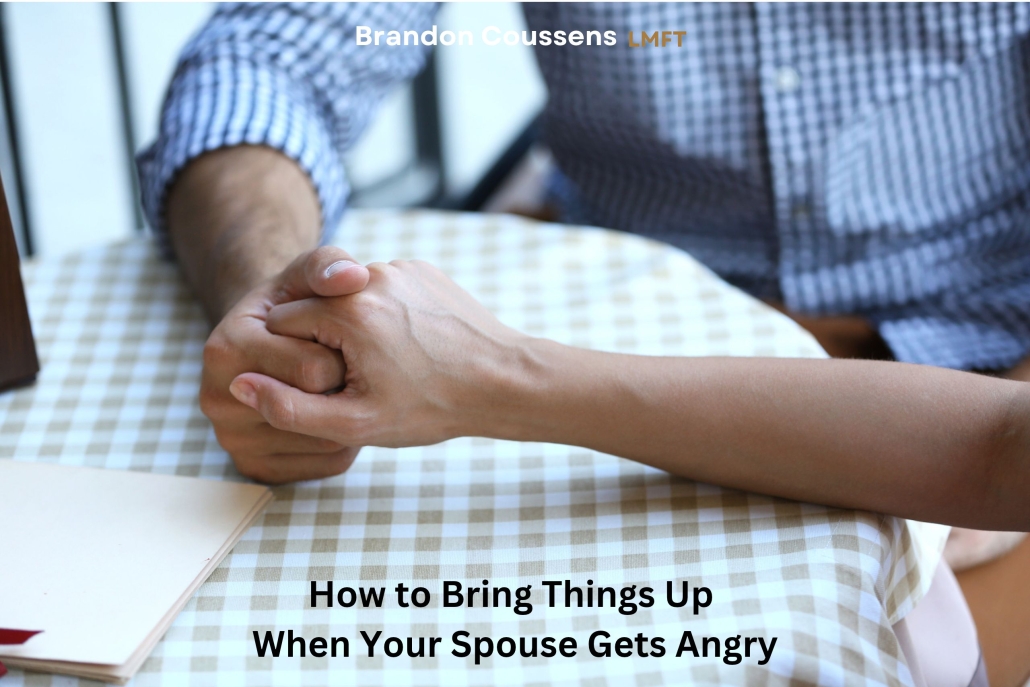
How to Bring Things Up When Your Spouse Gets Angry
If you’ve been walking on eggshells and you’re ready to start bringing things up again, I want to say this first: it’s going to be hard. Your spouse may not react well. But you’re taking the risk and doing your part, and that’s always worth it. You’re building a new skill. You’re reaching out and making what Dr. John Gottman calls a bid, an attempt to connect in a healthy way instead of an unhealthy one.
In my last post, I talked about how couples end up walking on eggshells and how to tell whether a marriage is stuck or unsafe. This one is for the stuck marriage. If you’re seeing signs that your marriage isn’t safe, please start with the safety steps in that post first.
What does “ready” look like?
When someone tells me they’re ready to bring things up again, the first thing I want to do is help them get clear on what that means. What do you want to bring up? What would it look like to do it well?
Then weigh the risk against what you want. If what you want can only happen by taking the risk, you have to decide whether it matters enough to you. Taking the risk doesn’t mean the bad reaction will happen. It means it’s possible. And how you bring it up can make a real difference.
That’s where we look for a new way to engage, something you may not have thought of. Sometimes it also means putting some boundaries or structure around how and when the two of you talk.
A different way to bring it up
One tool I use a lot is what Dr. John Gottman calls a soft startup. Instead of leading with the problem, you start by affirming your spouse. Let them know they’re important to you and that you want the two of you to be healthy and connected. Then tell them there are a few things you really feel are important to talk about.
It might sound something like this: “Hey, I just want you to know first that I love you, and you’re important to me. Our relationship is important to me. I think you’re an amazing person. I want us to connect. I want to understand you, and I want you to understand me. I’m coming to you because our relationship matters to me, and there are a few things I’d like us to talk about.”
You can shorten it or stretch it out to fit you. What matters is that your spouse hears that they’re loved before they hear what’s wrong.
Check whether it’s a good time. You can also ask if they’d be willing to just listen and hear you out before they respond. And if talking alone still feels like too much, ask whether they’d be willing to talk about it in front of a neutral party.
How you word it matters, too. Use “I” statements instead of “you” statements, and talk only about your side of things. It can even help to say it out loud: “This is my perspective, how it’s felt to me.” Take out the all-or-nothing words like “always” and “never.” That way you’re speaking in facts and truth instead of assumptions, and your spouse has less to push back against.
Keep your volume low and your tone soft, and leave out negative or critical words. Say what you want or need matter-of-factly, and put some love in it: “I know this might bother you or hurt you, but I really need this.”
When I’m working with someone on this, we’ll practice it together so they can see how it might go before they try it at home. Then I ask them what I’d ask you: are these ways you’ve already tried? If not, you may have more options than it feels like right now.
What’s going on with them?
This part can be hard to hear when you’ve been hurt. Sometimes the spouse who’s been tiptoeing settles into “Fine. I’m just not going to say anything.” I understand why. You tried, and you got knocked down.
What I’ve been telling my interns lately is to ask where the other spouse’s reaction is coming from. What’s underneath it? Are they angry? Are they fearful, hurt, or stressed? They’re human, and they have value, just as you do.
Sometimes your spouse is so reactive when you share your hurt because they don’t feel heard or understood either. And sometimes they can’t receive what you’re saying because they’re really hurt. You may have some areas of your own to work on, places where you need to listen to them and make amends for your part, so they’re more willing to open up.
So one thing that can help is listening first. Ask good questions and get their point of view before you share yours. Helping them feel heard gives space for you to be heard. Maybe not at the same time, and maybe not on the same day. But when you consistently open that door and offer a listening ear, love, and comfort, your spouse often becomes more open to what you have to say.
Listening first isn’t the same as taking responsibility for your spouse’s reactions. Their anger is theirs to manage. You’re just choosing to open a door, not carrying the whole relationship by yourself.
When it starts getting loud anyway
Even with a soft startup, your spouse may start getting loud or defensive partway through. When that happens, you have a couple of options.
One is to go back to listening first. Hear your spouse out, then summarize what you heard and check whether you understood them right. (If you’d like more on how to do that well, here are five steps to becoming a better listener.) When your spouse feels heard, they may be more willing to receive what you have to say.
The other is to ask for a break. Keep an eye on your own emotions. If you start getting too intense, or you feel scared and slip into that fear place, ask simply: “Can I have a moment to manage myself? I don’t want to say anything wrong, and I want to make sure I come back with the right attitude and the right words.”
How long depends on how upset you are. If you need five minutes, great. If you need more, say so: “Can I have twenty minutes to an hour?” And if you think you’ll need longer than that, you can say, “When I come back in twenty minutes to an hour, I’ll let you know if I’m ready.”
Then, as much as you can, be the one who comes back to it. Say, “I’m ready,” or “I’d like to talk,” or “I need a little more time.” That’s what keeps it from ending up under the rug again. When you do come back, you can ask your spouse if they’d be willing to listen to you the same way, hearing you out and summarizing what you said before they respond.
Either way, when it’s your turn, be direct and clear about what you want to say. Watch your tone, keep the affirmations in, and be honest. Let your yes be yes and your no be no.
What if it doesn’t work the first time?
Going to the gym one time doesn’t usually show results. Your marriage is the same. This pattern has been going on a while, and one or two attempts won’t break it, even if one of them goes well. It takes consistency from you, over and over.
Remember, your spouse may be on guard, too. They’ve learned to respond based on how you usually come to them, so they may not believe you’re going to come in a healthy way this time. If you’ve brought things up a certain way for years, they may sit back and wait to see if it’s real. Does he really want to talk? Is she really going to be kind? Trying something new can spark a “something’s different here,” but that doesn’t mean they’ll let their guard down right away.
It’s a little like a stray dog. If you try to feed him, he won’t come to you. But if you set the food down, he’ll come get a piece. The next time, he still might not come to you. It takes a while. You have to keep feeding him and keep trying.
A lot of us give up after the first or second try. So here’s the question: are you going to give up on something you really care about and really want, even if it takes a long time? Something I was taught a long time ago has stuck with me. The change might come the very next time you try, but you never know which time that will be. You could try a hundred times. What if the hundred and first is the one that turns the corner, and you quit on try one hundred?
That doesn’t mean you can never decide you’re done. That’s a choice, and it comes with its own outcomes and risks. That’s part of why it’s so important to work through what you really want and the risk that comes with it.
What it looks like when it starts to turn
In my office, things usually start to turn when one spouse begins to soften and really hear the other. Then you can see them both start hearing one another. At home, the spouse who used to react so strongly starts following through on what the tiptoeing spouse asked for, sometimes even when it wasn’t asked in the best way, because it was clear and direct.
When the tiptoeing spouse keeps being clear and direct, and gets past the fear of what might happen, and the other spouse starts to listen and respond in a healthy way, they really begin to connect. It’s a good thing to watch.
Where to start
If you’re walking on eggshells right now, you don’t have to keep living in that kind of quiet. Changing it doesn’t mean blowing everything up, either. It can begin with one soft conversation, and then another one after that.
If it doesn’t go well at first, keep trying, and get some help working through it. I work with couples and individuals through coaching, wherever you live. Coaching works best for people who want to change and are moving forward but feel a little stuck. We can practice these conversations together, and if it helps to bring your spouse in, I can sit in as a mediator for now while the two of you learn to do it on your own.
If the safety signs from my last post fit your marriage, please start with individual counseling with a licensed therapist where you live. If you’re in Georgia or South Carolina, our counseling team at Legacy can help.
Is there one thing you’ve been holding back that you’d be willing to try bringing up in a new way?
A lot of turning toward comes down to really hearing each other, like I talked about with my own habit of jumping in to fix things. My free communication guide walks through a few simple shifts that help your spouse feel truly heard. You can grab it using the button just below.

And if you’d rather have someone in the room while you work on this, I offer counseling for couples in Georgia and South Carolina, and coaching wherever you are.

Brandon Coussens, LMFT
Brandon Coussens, LMFT | Marriage Counseling and Sex TherapyAuthor:
Brandon Coussens is a Licensed Marriage and Family Therapist with over 16 years of experience helping couples reconnect and build healthier marriages. He owns Legacy Marriage Resources, LLC in Evans, GA, and offers counseling for couples in Georgia and South Carolina and coaching anywhere. You can learn more about Brandon on his About page.


