
Signs of an Emotional Affair (And Why You’re Not Crazy)
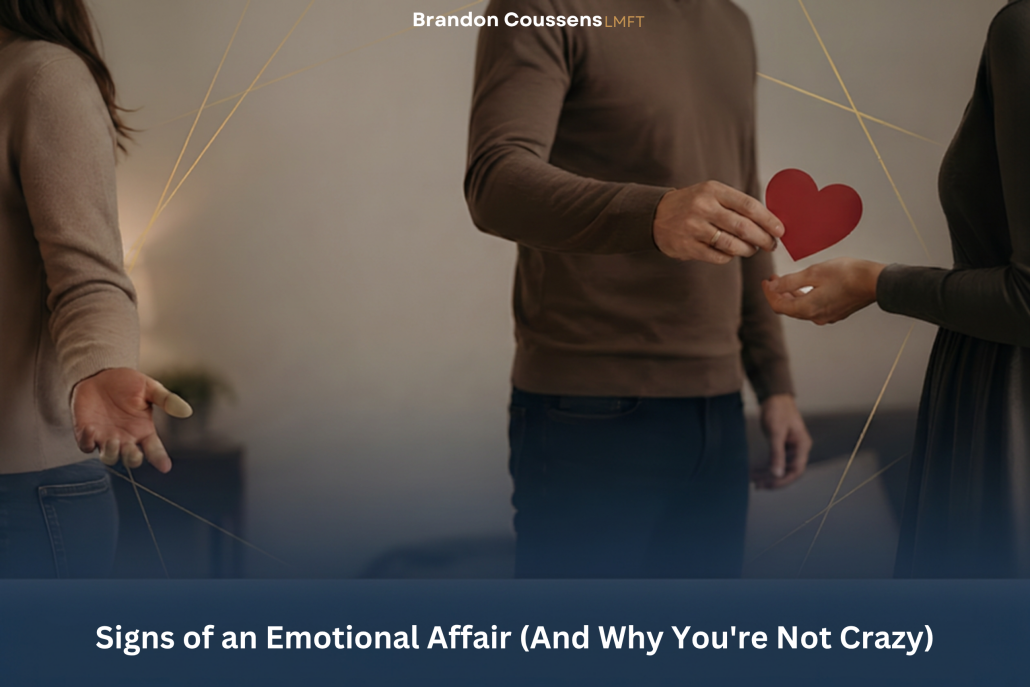
A while back, one of the clinicians in our practice worked with a couple where the husband had a standing guys night. That was the agreement. Just guys. His wife was fine with it until she saw a text on his phone that made it clear a woman had come along, at least once.
She was irate. He swore he did nothing wrong, that it had nothing to do with him, that he barely noticed her there. And he may have been telling the truth. Is that an affair? Not necessarily.
But she felt betrayed anyway, because he never told her.
If you’re reading this, something like that has probably already happened to you. You saw something, or felt something, and when you brought it up you got some version of “you’re overreacting” or “we’re just friends” or “you’re being paranoid.” Now you’re sitting there trying to decide whether to trust your gut or trust the person telling you your gut is broken.
You’re not crazy for thinking and feeling what you’re feeling.
I use the phrase perceived reality with clients a lot. Whether or not what you believe is happening turns out to be completely accurate, what you’re experiencing is real. It’s a normal response to what things look like from where you’re standing. That doesn’t mean you have all the facts. It means your reaction makes sense.
What an emotional affair actually is
The way I describe it is this. An emotional affair is when your spouse consistently gives something personal and deep to someone else, usually someone they’re drawn to, most often of the opposite sex, that should have been going to you. It’s ongoing, and it’s usually hidden.
That word “consistently” matters. One conversation that went further than it should have isn’t an affair. It’s a boundary that slipped, and it’s worth talking about, but it’s a different thing. An affair is a pattern. It’s choosing that person again and again, and choosing not to tell you about it each time.
It’s usually not sexual, because then we’d be talking about a physical affair. But the betrayal is real, and here’s why. What got given away was yours.
There’s a concept in Jimmy Evans’ book Marriage on the Rock called legitimate jealousy. The idea is that when a spouse gives something that rightfully belongs to their husband or wife to someone or something else, the hurt that follows isn’t insecurity. It’s a signal that something got taken. In an emotional affair, what’s being given away is usually time and vulnerability.
That’s the line. Not whether they touched. Whether they’re being known by someone else, over and over, in a way you’re not being let into.
I’ll be honest with you about something, because I think it helps. If you went looking for one clean, agreed-upon definition of an emotional affair, you wouldn’t find it. I looked. The researchers who study this don’t fully agree on where the line falls. Shirley Glass, whose book Not Just Friends is where a lot of therapists first learned to think about this, described it as secrecy plus emotional closeness plus a spark that hasn’t been acted on. Others define it a little differently. Across a lot of studies, there’s no single settled definition, and one large review that pulled together hundreds of them found emotional affairs are more common than most people assume. But here’s what they do agree on, and it’s the part that matters for you. If the connection is secret, if the closeness that belongs in the marriage is going somewhere else, and if it feels wrong, that’s worth paying attention to. Your gut is not nothing.
Why it’s so hard to name
Because it’s just talking. That’s what makes this one so slippery.
We all talk to close friends. We share things with a sibling or a parent that our spouse never hears, and nobody calls that cheating. So when you try to explain why your spouse texting a coworker until midnight feels like a knife, it can sound thin even to you.
Most of the time the difference is who it is. It’s rarely an emotional affair with your brother or your best friend of the same sex. Though I’ll tell you, even those can sting if your spouse is confiding the thing you wish they’d confided in you. That’s a different problem, but it still hurts.
This is where most people go quiet. Nothing physical happened, so you talk yourself out of it. You decide you’re the problem for noticing.
What you might be seeing
The signs of an emotional affair aren’t always obvious, and I want to be careful here, because a list like this can turn into a case file if you let it.
You might notice your spouse guarding their phone in a way they didn’t used to. Spending more time alone. Not wanting as much time with you. Getting quieter, sharing less about their day. Seeming irritable or defensive when a certain name comes up. If you ask to see their phone and they get frustrated or flat out say no, that’s a problem. If passwords change or if your questions keep getting met with vague answers or a change of subject, that may be a problem.
You might also notice something in yourself. If you’re making excuses for your partner to your friends or to yourself, that’s worth paying attention to.
None of these are proof. They’re feathers in your cap. Things to watch, not verdicts to hand down.
It’s not okay to accuse. It is okay to be aware, mindful, and vigilant. But we don’t want to take one thing and build a whole story around it, because what if they aren’t doing anything? Then you’ve spent three weeks prosecuting a case instead of living in a marriage. Stay in a posture of grace and openness while still being honest about what you need.
I’ll tell you something from my own life. At an old job, there were times I could have overshared with someone, been a little too open. A time or two, I was. Nothing dramatic, and nothing I was doing on purpose. But I’d drive home and feel a little concerned about how my wife might respond if she knew.
She never caught me at anything, because there wasn’t anything to catch. But she could feel that something was off. How? Because I’d come home distant. That’s the part I want you to hear. The distance showed up before anything else did.
I had to figure out for myself why I was being that open with someone who wasn’t my wife, and then learn to bring that openness home instead.
Why it hurts when nothing physical happened
Think about being a kid, and your parents take your sibling on a trip and leave you home. Nobody hit you. Nothing happened to you. And it wrecked you anyway.
Sometimes there’s more to it than talking. Money gets spent. Gifts, lunches, little things that look innocent one at a time. But even when there’s none of that, the wound is the same shape. Something that was supposed to be yours went to someone else.
I remember in college, a friend I’d been close to all through high school got into a fraternity and started spending all his time with new guys. He didn’t do anything wrong, technically. I just felt left out and alone, and I started wondering if the friendship I thought I had was ever what I thought it was.
Now take that feeling and put it inside a marriage, where you promised each other you’d be the one. This is why “but nothing happened” lands so hollow. Research on betrayal finds that a large share of people who go through it, somewhere between a third and half, end up carrying symptoms that look like trauma. Anxiety, intrusive thoughts, trouble trusting. That’s not you being dramatic. That’s what betrayal does to a person, whether or not anyone ever touched.
How these things usually start
Almost nobody wakes up and decides to have an emotional affair.
It usually starts in the mind, and it usually starts when something in the marriage is already hurting. You’re not being seen. You’re tired, or lonely, or the two of you have been passing each other in the hallway for months. Then somebody gives you attention, or you notice something about someone else that looks better than what you have at home, and that comparison sits there.
So you crack the door. Just a little. And it feels good, and it doesn’t seem like a big deal, because it wasn’t. Nobody got hurt. Nothing happened. And that’s exactly what makes it easier to open a little wider next time.
It looks a lot like how addiction starts. One drink, one conversation, one late text. Then the justifying kicks in. It’s not that bad. At least I didn’t do what other people do. And anyway, I’m only here because I’m not getting this at home.
The door doesn’t fly open. It gets pushed a half inch at a time by somebody who keeps telling themselves it’s still closed.
The fork in the road
Here’s what I need you to hear, and I want to be direct about it.
If the marriage was already hurting before any of this started, that matters. Both of you will have to look at it honestly if you want to rebuild something real instead of just patching a hole. Distance, unmet needs, years of not feeling close, all of that is part of the story.
But none of it makes the affair your fault.
There was a fork in the road, and your spouse stood at it. When that pull showed up, they could have come to you and said, “Something’s going on with me. I’m struggling. This felt good, and I know it was wrong, and I need us to talk about it.” Some people do exactly that, and those marriages usually make it. Or they could keep it quiet, enjoy it, and tell themselves it wasn’t hurting anybody.
That choice was theirs. Not yours.
The scripture I’d reach for here isn’t about keeping no record of wrongs, and I’ll say that plainly, because that verse gets used to tell hurting spouses to hush up. The one that fits is about bringing things into the light. In the very first chapter of the Bible, two people become one flesh. That means there isn’t supposed to be a room in the house one of them isn’t allowed in. Hiding is what lets the thing grow. Telling the truth early is what protects the marriage. It isn’t a rule to make anyone feel small. It’s the design.
If they actually hear you
If you do get to the conversation, here’s what to listen for.
You’re not listening for a confession. You’re listening for whether they can say something like, “I can see how that looked to you, and I’m sorry I put you in a spot where you had to wonder. Here’s what was actually going on, and here’s what I’m going to change so you don’t have to feel that again.”
That’s a spouse who’s hearing you, even if they’re innocent. Especially if they’re innocent.
If instead every question gets met with defensiveness, or you somehow end up being the one apologizing, that tells you something too. Not proof. Just something you didn’t know before.
So what do you do if this is where you are?
Don’t confront and explode. Don’t stay silent and let it eat you either. There’s a middle path, and it starts with you, not with them.
First, let yourself feel it. Cry if you need to. Acknowledge that you’re hurt and jealous and scared, and don’t rush past that to get to the questions.
Then acknowledge what you don’t know. You may not have the whole picture, and there may be a piece missing that changes everything. Go in wanting to understand, not wanting to win.
Ask for a time to talk instead of ambushing them. Tell them you love them and you’re concerned, in that order. Ask real questions instead of accusatory ones. And agree on some ground rules before you start. No yelling, no cursing, no throwing things, no threatening divorce. Normal hurt is allowed. Crying is allowed. Needing to stop and take twenty minutes to breathe is allowed, as long as you say so instead of walking out.
Find one person you trust who will give you perspective instead of gasoline. Pray about it. Journal if that helps you think. Ask yourself what you need in order to feel steady enough to have this conversation well.
Before you go
You’re not crazy. You’re scared, and that’s a normal thing to be when you love somebody, and you can feel them drifting.
You might be right. You might be missing something. Either way, pushing too hard right now can make it worse, and staying silent will just leave you alone with it.
So breathe. Talk to someone you trust. Ask for the conversation. And if you get in there and it’s bigger than the two of you can hold, that’s what counseling is for, and it isn’t a last resort. I work with couples and individuals through this, in person and remotely, and I’d be glad to sit down with you and sort out what’s real and what’s next.
You’re not stuck. You just don’t have the whole picture yet.
A note on sources
Before writing this, I spent time with both clinical experience and the research on emotional infidelity. I’ll be honest with you about what that research says, because it’s more reassuring than you’d think. The experts don’t fully agree on one tidy definition of an emotional affair, and a large 2024 review of hundreds of studies found exactly that, along with the finding that emotional affairs are more common than most people assume. That lack of a clean definition is part of why this is so confusing to live through. What the research does agree on is simpler and truer: when closeness that belongs in a marriage is going somewhere else in secret, and it feels wrong, it’s worth taking seriously. And if you’re wondering whether you’re overreacting, know that research on betrayal has found a real share of people who go through it carry symptoms that look like trauma. Your gut is in good company.
Want to read more?
If you want something written for you and not for a research journal, Shirley Glass’s Not “Just Friends” is the one I’d point you to. It’s warm, it’s clear, and it was written for exactly the person reading this.


