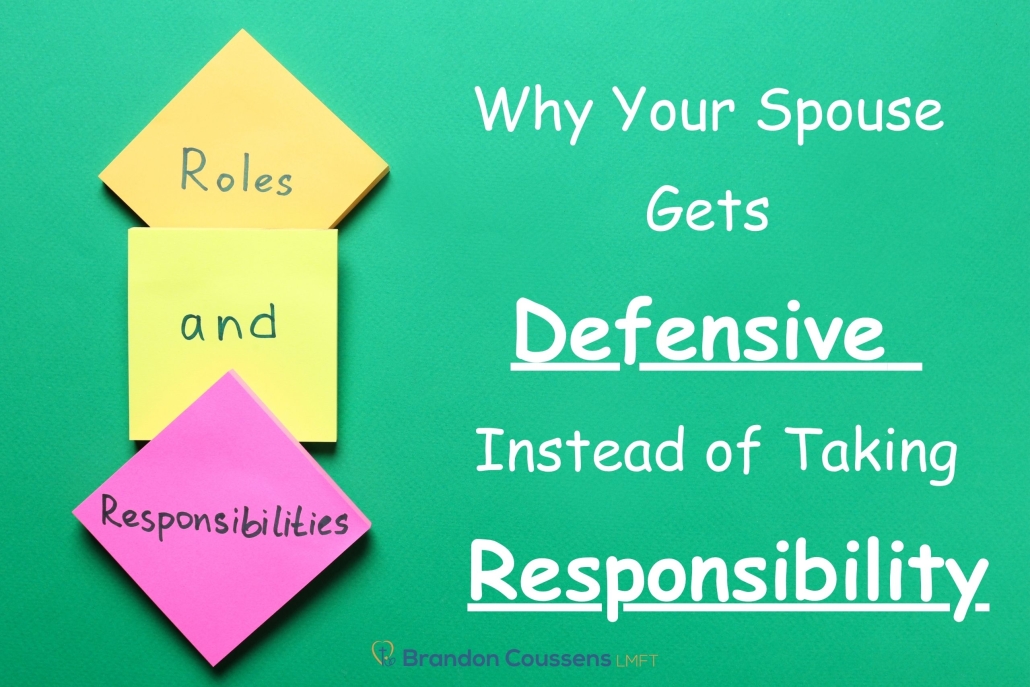
Why Your Spouse Gets Defensive Instead of Taking Responsibility in Marriage
Taking responsibility in marriage sounds simple. But if your explanation came out before you owned what happened, there’s a good chance your spouse stopped listening.
You probably had reasons. Real ones to explain yourself. But if your explanation came out before you owned what happened, there’s a good chance they stopped listening, not because they’re unreasonable, but because it sounded like you were trying to get out of it.
I’ve done this myself. A while back my wife and I were on vacation and I was parking the car. I dropped everyone off, went to find a spot, and when I backed up I caught a pole I couldn’t see. It was lower than the windows, someone was behind me, I was rushing. When I got back and told my wife what happened, I went straight into all of that. The pole was small. I couldn’t see it. There was a car behind me. She kept asking questions and I got frustrated.
What I didn’t do was just say, I wasn’t paying close enough attention and I made a mistake.
That’s a small example, but it shows up the same way in my counseling office. One spouse starts telling a story about something that hurt them. The other cuts in with context, reasons, more information. And instead of the first person feeling heard, they feel like their spouse is trying to talk them out of what they felt. Then they’re both frustrated, both shut down, and nobody feels understood.
Why we reach for the explanation first
Here’s what’s usually happening underneath it. You’re scared. You don’t want your spouse to be angry. You don’t want the disconnection, the argument, the cold night. You feel like if they just understood the full picture, they wouldn’t be as upset. So you give them the full picture, fast.
What you’re actually protecting in that moment is how you look. Maybe there’s some shame in there. Maybe guilt. And sometimes the explanation is true, every word of it, but it still functions as a way to make something that wasn’t okay sound more okay than it was. Your spouse can feel that, even if they can’t always name it.
Taking responsibility in marriage means more than giving context
Context is the details of what was going on. Responsibility is what you chose, and what that choice did to the other person.
Responsibility, the way I think about it, is your ability to respond. It’s the actual behaviors, the things you did or didn’t do. In a marriage those things add up into roles and expectations, agreements you’ve made or just kind of fallen into over time. Context is everything around those behaviors. And context isn’t bad. But context without ownership first just sounds like an excuse.
Think about it this way. Say you’re a manager named Tony and your team missed a major deadline. Your boss comes to you. Tony could say, well Bobby didn’t finish his part, the shipment came in late, and George showed up late that one day. His boss is still going to say, Tony, I understand all that, but you’re accountable for the outcome. That’s your project.
Now say Tony walks in and says, I know the company was counting on this and I didn’t come through. Nobody is more accountable for that than me and I have work to do. His boss, instead of coming down hard, starts reflecting on his own part. Maybe he put Tony in that role too soon. Maybe he could have supported him better. Tony’s humility pulled accountability out of his boss too.
That’s what ownership does. It tends to invite more of itself. When you stop defending and just say what’s true, it creates space for the other person to do the same. And that’s where things actually start to move.
The same thing happens at home.
What defensiveness does to your spouse
When you get defensive, you feel safer. You feel like you’re managing the situation, giving them something to work with.
Your spouse feels alone.
I had a couple in my office where the husband got defensive mid-conversation and his wife just shut down. I asked her what she was feeling and she said, he’s never going to get it. He doesn’t care. He won’t listen.
He thought he was explaining himself. She experienced it as him not caring about her pain.
That’s the gap defensiveness creates. You walk away feeling misunderstood. They walk away feeling like you chose being right over being close to them.
What real ownership sounds like
It doesn’t have to be a long speech. It actually works better when it isn’t.
“I was wrong.”
“I hurt you.”
“I understand why that damaged your trust.”
“I’m not asking you to get over it quickly.”
Those land differently than “I’m sorry you feel that way” or “I’m sorry that hurt you.” The second set isn’t really an apology. It’s a way of closing the argument without actually entering it. A real apology acknowledges that the other person is wounded and that you had something to do with that. Taking responsibility in marriage doesn’t require a long drawn out explanation or theatrical moment. You don’t need to grovel or bed.
There’s a version of sorry that heals and a version that just ends the conversation. Your spouse knows the difference, even if they can’t always explain why one feels hollow.
Context can still have a place, just not first
Once you’ve owned it, once you’ve actually said what you did and acknowledged how it landed, context can be helpful. It can help your spouse understand you better and fill in the picture in a way that brings you closer.
But the order matters. Context first and it reads as blame-shifting. Ownership first and context becomes information instead of defense.
You might even say it out loud: “I want to explain what was going on, but I want to make sure you know first that I take responsibility for this.” That one sentence changes the whole tone of what comes next.
A word for the spouse who keeps feeling unheard
If you’re the one on the other side of this, the one who brings something up and keeps getting explanations instead of ownership, I want to say something to you directly.
It’s exhausting. And you’re not wrong for wanting more than an excuse.
One thing that can help is how you bring it up. When people feel cornered or criticized, defensiveness is almost automatic. That’s not an excuse for it, but it does mean that starting with “I felt hurt when…” tends to open a door that “you always do this” closes. You’re not responsible for managing their defensiveness, but you do have some influence over the conditions that make ownership easier or harder.
And if you’ve tried that and it still isn’t landing, that’s worth talking to someone about. Not because something is wrong with you, but because some patterns are hard to shift without a third person in the room.
Something to try
If this is a pattern in your relationship, here’s a simple place to start. Get a piece of paper and make two columns.
On one side write: What I want them to understand about me. On the other side write: What I need to understand about them.
Sit down together and share what you wrote. It slows the conversation down and gets both people curious instead of defensive.
You can also go back to a specific situation where things went sideways and practice. Not to relitigate it, just to try it differently. “I’m sorry for this. I want to do better.” That’s it. See how it feels to just let that land without adding anything else.
If you’re the one who keeps being told you’re defensive and you genuinely don’t see it, I hope something here helped you understand what your spouse might be experiencing. You probably aren’t trying to avoid responsibility. You probably just got into the habit of explaining first.
And if you’re the one who keeps feeling unheard, that gap is real and it can close. It usually takes both people being willing to learn a different way.
Author: Brandon Coussens, LMFT

If you want to practice this together, my Couples Communication Workbook turns these same ideas into step-by-step exercises you and your spouse can work through at home, at your own pace.

And if you’d rather have someone in the room while you work on this, I offer counseling and coaching — for couples in Georgia, and coaching wherever you are.